29-30 Oct 2026
course - Leadership Communication & Conflict Resolution (2-Day)
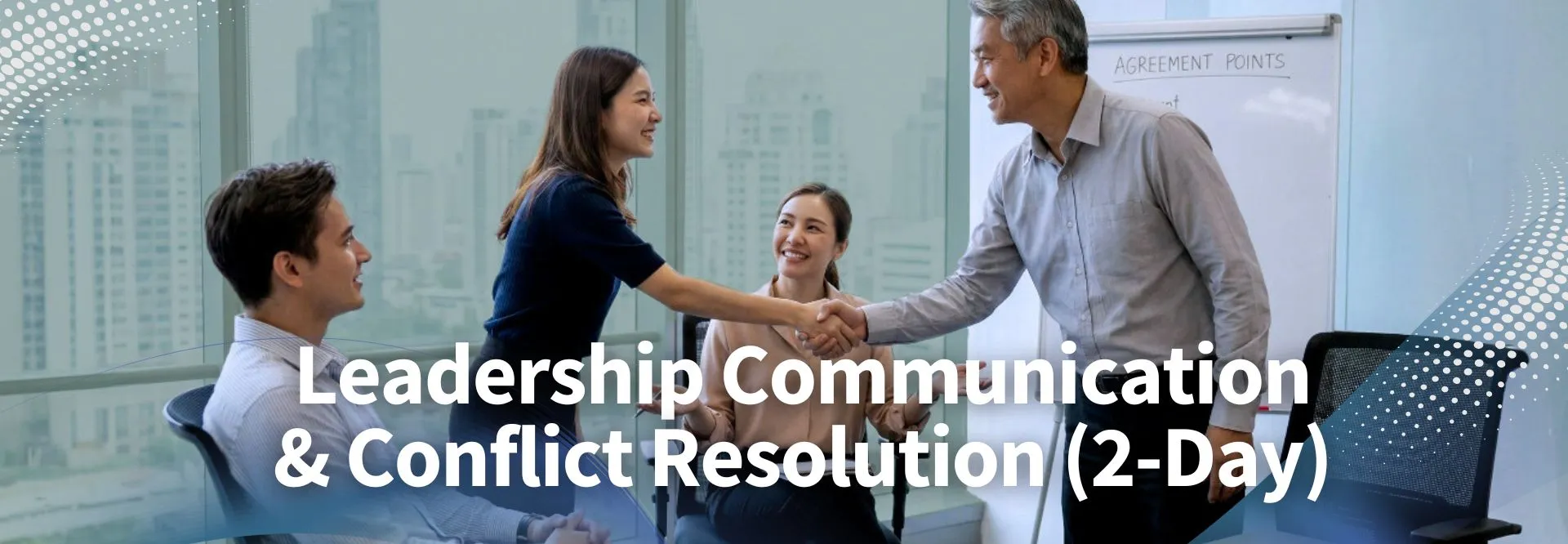
Leadership Communication & Conflict Resolution (2-Day)
Our programs are trusted by over 10,000 professionals from public and private sectors
SCHEDULE
| DATE: |
TIME: 9am – 5pm |
| LOCATION: Amara Singapore |
| Normal (from 9 Oct 2026) |
Early Bird (by 8 Oct 2026) |
Group of ≥3 (by 8 Oct 2026) |
| S$1,675.80 |
S$1,533.00 |
S$1,396.50 |
OVERVIEW
Civil service leaders today operate in an increasingly complex environment. They lead multi-generational teams, balance performance expectations, collaborate across departments, respond to citizen concerns that can quickly amplify through social media, and resolve conflicts that may escalate into public scrutiny or reputational crises.
This intensive two-day program provides practical frameworks for navigating high-stakes conversations where logic alone isn’t enough. While policies, procedures, and data are important, emotionally charged situations require understanding the human needs driving resistance before rational solutions can take hold.
Drawing on Nonviolent Communication (NVC) — the same framework Microsoft CEO Satya Nadella used to transform a conflict-ridden leadership team — you’ll learn how to de-escalate tension, uncover underlying needs, and foster constructive problem-solving.
What's Unique About This Leadership Communication & Conflict Resolution Workshop?
Communication That Goes Beyond Techniques
Many communication courses teach scripts or persuasion tactics. This workshop focuses on the mindset and consciousness behind communication, helping participants respond thoughtfully rather than reacting automatically during conflict.
Needs-Based Conflict Resolution
Participants learn to move beyond the traditional “who is right or wrong” conflict model by identifying the underlying needs driving behaviour, enabling more constructive and collaborative outcomes.
Empathy as a Practical Leadership Skill
Empathy is treated as a trainable professional skill, not merely a personality trait. Participants learn structured listening methods that surface the feelings and needs behind messages.
Designed for Real Workplace Situations
The training uses realistic workplace scenarios, including hierarchical environments, cross-department collaboration, and public-facing interactions.
Grounded in a Proven Communication Framework
The workshop is built on Nonviolent Communication, a structured process that emphasizes empathy, needs-based dialogue, and judgment-free communication to strengthen trust and cooperation.
FAQ About Leadership Communication & Conflict Resolution Workshop
What is Nonviolent Communication (NVC)?
Nonviolent Communication, developed by Dr. Marshall B. Rosenberg, a renowned psychologist, is a structured communication framework designed to promote empathy, needs-based dialogue, and compassionate listening while reducing judgment and blame in conversations.
Is this a “soft skills” or counselling-based programme?
It is both. The workshop focuses on leadership communication during difficult interactions, particularly conflict situations, feedback conversations, and emotionally charged exchanges.
Is this relevant for experienced, senior leaders?
Yes. The programme is designed for leaders at all levels managing downward to their teams, upward to supervisors, and laterally across agencies where escalation risks and complex stakeholder dynamics are common.
Will participants practise real conversations?
Yes. The workshop includes guided scenario drills based on realistic professional situations, followed by facilitated debriefs to reinforce learning.
Is the approach applicable across different roles and sectors?
Yes. The skills are role-agnostic and transferable across leadership, governance, and management contexts.
Join 10,000+ professionals who have benefitted from our workshops. Register now.
BROCHURE REQUEST

Looking to learn more about our workshop? Fill in this form to request a brochure from us now!
REQUEST SUBMITTED
Your request has been submitted. We will get back to you in 3 working days.
WHO SHOULD ATTEND
Professionals who need to manage difficult conversations constructively
Managers, supervisors, and team leaders
Public sector officers and administrators
HR professionals and people managers
Project managers leading cross-functional teams
Officers involved in stakeholder or public engagement
BRIEF PROGRAM OUTLINE
Foundations of Empathy & NVC
Introduction to the NVC communication model
Observations vs. evaluations
Understanding feelings and universal human needs
Formulating clear, actionable requests
Practical Empathy Skills
Deep listening and presence
Translating criticism and blame into underlying needs
Practising self-empathy and emotional awareness
Handling Difficult Conversations
Managing anger, defensiveness, and resistance
Responding to emotional reactions with empathy
Expressing concerns without blame
Conflict Resolution Tools
Needs-based dialogue
Requests vs. demands
Collaborative strategies that meet multiple needs
Real-World Workplace Application
Role-play exercises and scenario practice
Giving and receiving challenging feedback
Expressing appreciation constructively
Applying NVC principles to teamwork & organizational collaboration
WHAT YOU WILL LEARN
Apply the four-part NVC communication model
Recognize the unmet needs behind emotional reactions & workplace tension
Communicate concerns clearly without blame or criticism
Listen empathically and understand the perspectives of others
Manage difficult conversations with emotional steadiness
Transform workplace disagreements into constructive dialogue
Build trust-based professional relationships across teams
Create psychologically safe communication environments that support collaboration and productivity